

 Posted on Google
 George Rone
Trustindex verifies that the original source of the review is Google.
I received great care for my shoulder here. The staff was extremely kind and welcoming!Posted on Google Lena ChachankoDr. Maribel and Jordan were great at explaining and making me comfortable. The laser was great and helped me relax. It is a good environment, I’d definitely recommend this place!Posted on Google
 Devin SainDr. Maribel she did a wonderful job working on me my first day coming here my pain dropped a lot getting helped from her. I was at 8 pain level and it dropped to a 2 she did some needle work on my lower back Area it felt really good So I recommend it if you have lower back pain and also she used tape on my lower back it feels really good. Overall I highly recommended her Dr. Maribel 10 out of 10 my first day coming in I felt really comfortable getting helped here in this areaPosted on Google
 Ann HollenbergerI have been coming to physical therapy since June. Dr. Maribel is wonderful, caring & has helped me a lot with my pelvic therapy. Jordan is the best! She’s very personable, kind , and always smiling! Love them. ❤️❤️Posted on Google
 John ReillyI'm about six weeks post major surgery for a condition called Neurogenic Thoracic Outlet Syndrome. It's basically nerve crush due to whip-lash, repetitive stress etc. I'm feeling very lucky that I have Dr. Maribel and Chesterton Physical Therapy helping me with my recovery. Mine is a long road back and their team has been helping me every step of the way. E-stim, laser, ultrasound, heat/ice, and dry-needling have all been used to help my muscles calm down and respond to treatment. The exercises they've implemented for me thus far are creative and perfectly matched to where I am in my recovery. The team is incredible - Alex, Adam, Neal, Jordan, Lucy, Sir John etc. - everyone is friendly, caring and genuinely wants to help you. Dr. Maribel oversees it all and designs customized treatment plans to get you where you need to go. She runs a tight ship and has hired a great staff. I have many sessions more to go and look forward to each one. Highly recommend!Posted on Google
 Peggy ArnettJacob, Dr Maribel, Adam is really outstanding. They will push you to work harder. Highly recommend CPT!!!Posted on Google
 Lexi PedeDr. Maribel and Jordan are fantastic :) thank you so much for your help!Posted on Google
 Desirae ThompsonAll of the staff is very welcoming, they are like a big family and care for both the staff and patients. I see Dr. Maribel, she really tries to pinpoint what you need help with by asking many questions, which if you’re very anxious like me and don’t know how to talk to people helps tremendously.Posted on Google
 Jackie GonzalezAll personal very friendly and professional, a great place for physical therapy, Dr Maribel Bacalan very nice, and tech Miss Jordan very helpful and friendly and john friendlyPosted on Google
 Rafael MoraMy experience with Dr. Neil and the whole team was great. Everyone I met was very friendly and supportive! Overall great experience and helped alleviate my pain tremendously!Verified by TrustindexTrustindex verified badge is the Universal Symbol of Trust. Only the greatest companies can get the verified badge who has a review score above 4.5, based on customer reviews over the past 12 months. Read more
If you are dealing with sciatic pain, even simple movements can feel uncomfortable. Pain that travels from your lower back into your buttock or leg can make sitting, walking, sleeping, and working more difficult. You may be wondering what you can safely do at home to feel better without making the problem worse.
Sciatica refers to symptoms caused by irritation or pressure on the sciatic nerve, which runs from the lower back through the buttocks and into the legs. The right exercises can help some people stay active and manage symptoms, but no single exercise is appropriate for everyone.
This article covers sciatica exercises at home that are generally gentle starting points. A physical therapist can help determine which movements are appropriate for your specific symptoms and whether another type of treatment is needed.
Sciatica is a term used to describe pain or other symptoms that follow the path of the sciatic nerve. It often affects one side of the body and may cause pain, tingling, numbness, or weakness in the buttock or leg.
Several problems can contribute to sciatic symptoms, including irritation around the lower spine. Because the cause and symptoms can vary from person to person, an exercise that feels helpful for one person may aggravate symptoms for another.
For that reason, think of these movements as gentle self-care options—not a diagnosis or a replacement for a personalized evaluation.
Exercise should not be used to push through serious or rapidly worsening symptoms. Stop exercising and seek medical care immediately if you develop:
If your symptoms are mild and stable, begin slowly. A gentle stretch or exercise should not cause your pain to travel farther down the leg or become significantly worse afterward.
You do not need to perform every exercise. Start with one or two movements that feel comfortable, and stop if your symptoms worsen.
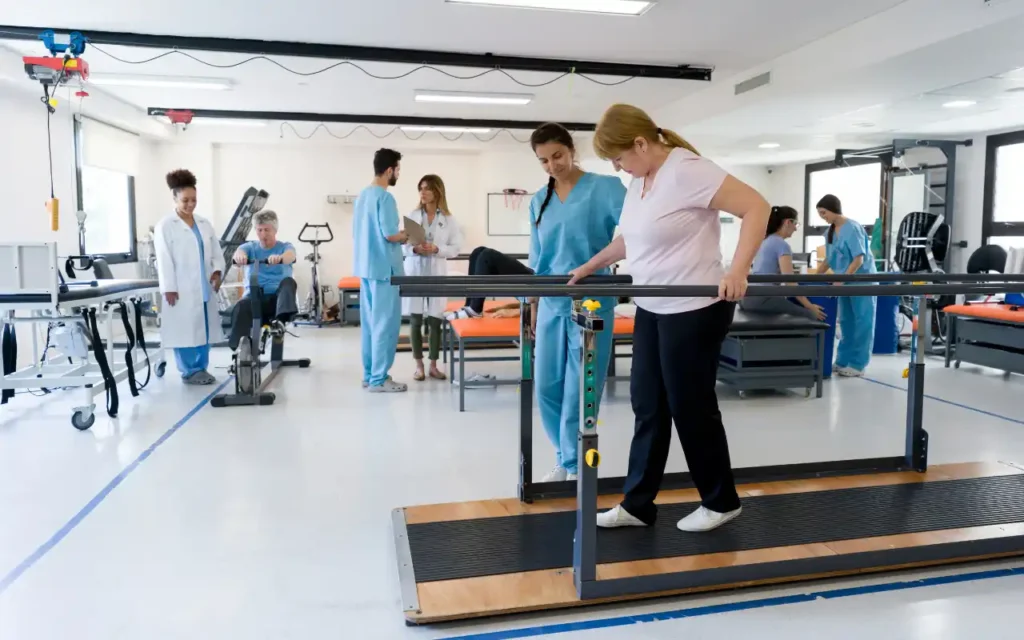
Walking is one of the simplest home exercises for back pain and may be a useful way to avoid staying in one position for too long.
How to do it:
What it helps with:
Gentle movement can help you stay active when prolonged sitting or bed rest makes you feel stiff.
Caution:
If walking causes pain to travel farther down your leg or significantly increases your symptoms, stop and discuss it with a healthcare professional.
Pelvic tilts provide gentle movement through the lower back and can be a comfortable starting exercise for some people.
How to do it:

What it helps with:
This exercise gently moves the lower back and helps you practice controlled movement.
Caution:
Keep the movement small and comfortable. Do not force your back into a position that increases leg symptoms.
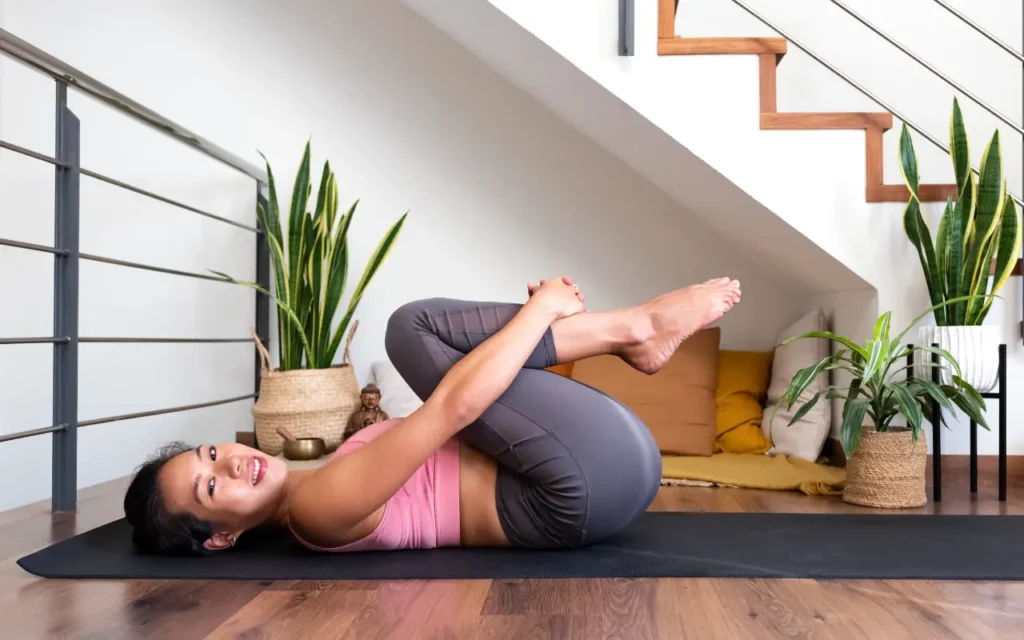
This gentle stretch can help some people who feel tight through the lower back or hips.
How to do it:
What it helps with:
It provides a gentle stretch to the lower back and hip area.
Caution:
This movement is not right for everyone with sciatica. Stop if it increases leg pain, numbness, or tingling, especially if symptoms travel farther down the leg.
Tightness around the back of the thigh can sometimes make movement uncomfortable. A gentle hamstring stretch may be appropriate for some people.
How to do it:

What it helps with:
This can gently improve flexibility around the back of the thigh.
Caution:
A nerve-related symptom can sometimes feel similar to a muscle stretch. Do not force the stretch or try to “stretch out” sharp, burning, tingling, or shooting pain.
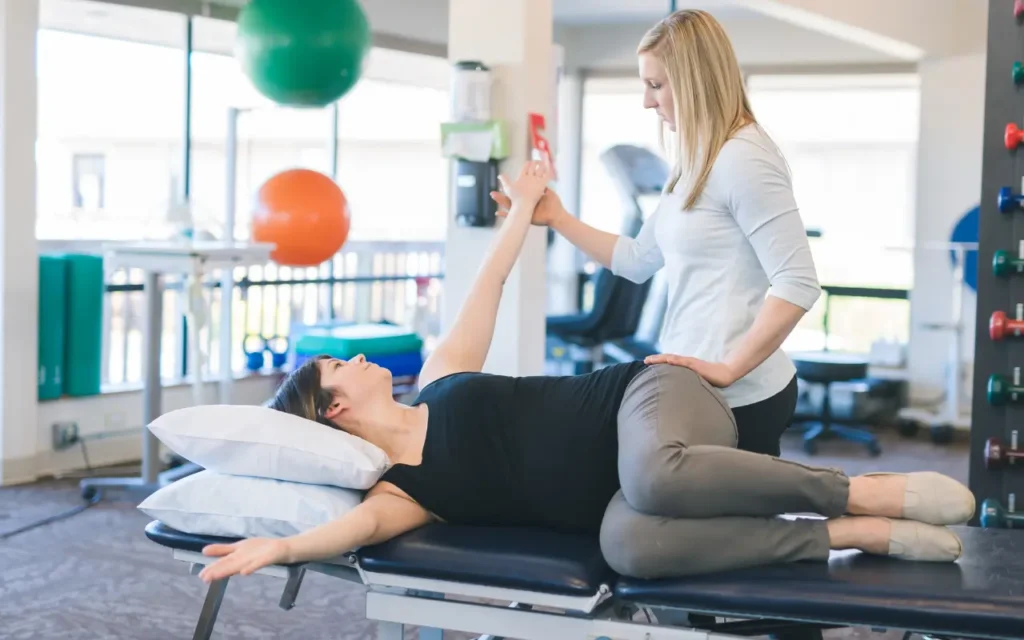
Some people with certain types of lower-back-related symptoms find gentle backward movement more comfortable. However, this exercise is not appropriate for everyone.
How to do it:
What it helps with:
It gently moves the lower back through extension, or backward bending.
Caution:
Stop if the exercise increases your leg pain or causes symptoms to travel farther down the leg. If symptoms become more centralized toward your lower back and less noticeable in your leg, that can be useful information to share with a physical therapist—but it does not by itself identify the cause of your symptoms.
When looking for how to relieve sciatic nerve pain, more exercise is not necessarily better. Gentle movement, changing positions regularly, and avoiding activities that clearly aggravate your symptoms can be more useful than forcing stretches.
You can also keep track of what makes your symptoms better or worse. For example, note whether sitting, walking, bending, or lying down changes your symptoms. This information can help a physical therapist understand your movement pattern and create a more personalized plan.
These simple sciatica pain relief tips are meant to complement professional care when needed—not replace it.
Home exercises can be a reasonable first step for mild, stable symptoms, but they cannot provide the same individualized information as a physical therapy evaluation.
A physical therapist can assess how your lower back, hips, legs, strength, flexibility, and movement patterns are contributing to your symptoms. They can then select exercises based on your specific presentation instead of relying on a one-size-fits-all routine.
Physical therapy may also include hands-on techniques when appropriate, movement education, progressive strengthening, and tracking your response to treatment over time. Your program can be adjusted as your symptoms improve or change.
If your symptoms are not improving after about 1–2 weeks, are interfering with normal activities, or are getting worse, consider getting evaluated rather than continuing to experiment with exercises on your own.
If you’re ready to take the next step, you can schedule a back pain and sciatica evaluation or request an appointment with Chesterton Physical Therapy.
Indiana allows patients to access physical therapy directly without first obtaining a physician referral, subject to state requirements and applicable insurance rules. Indiana’s direct-access provisions allow a physical therapist to evaluate and treat a patient without a referral for up to 42 calendar days from the start of treatment; additional care may require a referral.
Chesterton Physical Therapy has locations serving patients in physical therapy in Chesterton, IN and physical therapy in Valparaiso, IN, along with locations in Michigan City and Portage.
Recovery time varies depending on the cause, severity, and individual factors. Some people improve within days or weeks, while others may have symptoms that last longer. If your symptoms are worsening or are not improving, a healthcare professional can help determine the appropriate next step.
Gentle walking can be a reasonable way to stay active for some people with sciatica. Start with a comfortable amount and increase gradually if it does not worsen your symptoms. If walking increases or spreads your leg pain, stop and seek personalized guidance.
You should not try to forcefully stretch a “pinched” sciatic nerve. Some sciatica stretches may feel comfortable, but nerve-related symptoms can respond differently depending on the underlying problem. Stop any stretch that increases shooting pain, tingling, numbness, or symptoms farther down the leg.
For more helpful information, see answers to common patient questions.
Sciatica exercises at home can be a helpful way to stay active and manage mild, stable symptoms. Gentle walking, pelvic tilts, knee-to-chest stretches, hamstring stretches, and other comfortable movements may support mobility—but it is important to listen to your body and avoid pushing through pain.
Because sciatica symptoms can have different causes, there is no single exercise routine that works for everyone. If your pain is getting worse, spreading farther down your leg, or interfering with your daily activities, a personalized evaluation can help you understand the right next steps.
Don’t let back and leg pain keep you from doing the things you enjoy. At Chesterton Physical Therapy, our physical therapists can evaluate your symptoms and create a personalized treatment plan based on your specific needs and movement limitations.
Ready to take the next step? Schedule a back pain and sciatica evaluation or request an appointment today.
Chesterton Physical Therapy proudly serves patients in Chesterton, Valparaiso, Michigan City, and Portage, Indiana.
Disclaimer: This article is for educational purposes only and is not a substitute for a personalized medical or physical therapy evaluation. Exercises may not be appropriate for every person or condition. If you have severe, worsening, or concerning symptoms, seek appropriate medical care.
Neck & Shoulder Pain Relief – No Meds. No Surgery.
Get expert tips and simple exercises to feel better — naturally and safely.
🔒 We respect your privacy. No spam, ever. 🤝
✅ Backed by certified experts at Chesterton Physical Therapy
💡 Trusted by 1,000+ patients in Chesterton, Portage & Michigan City